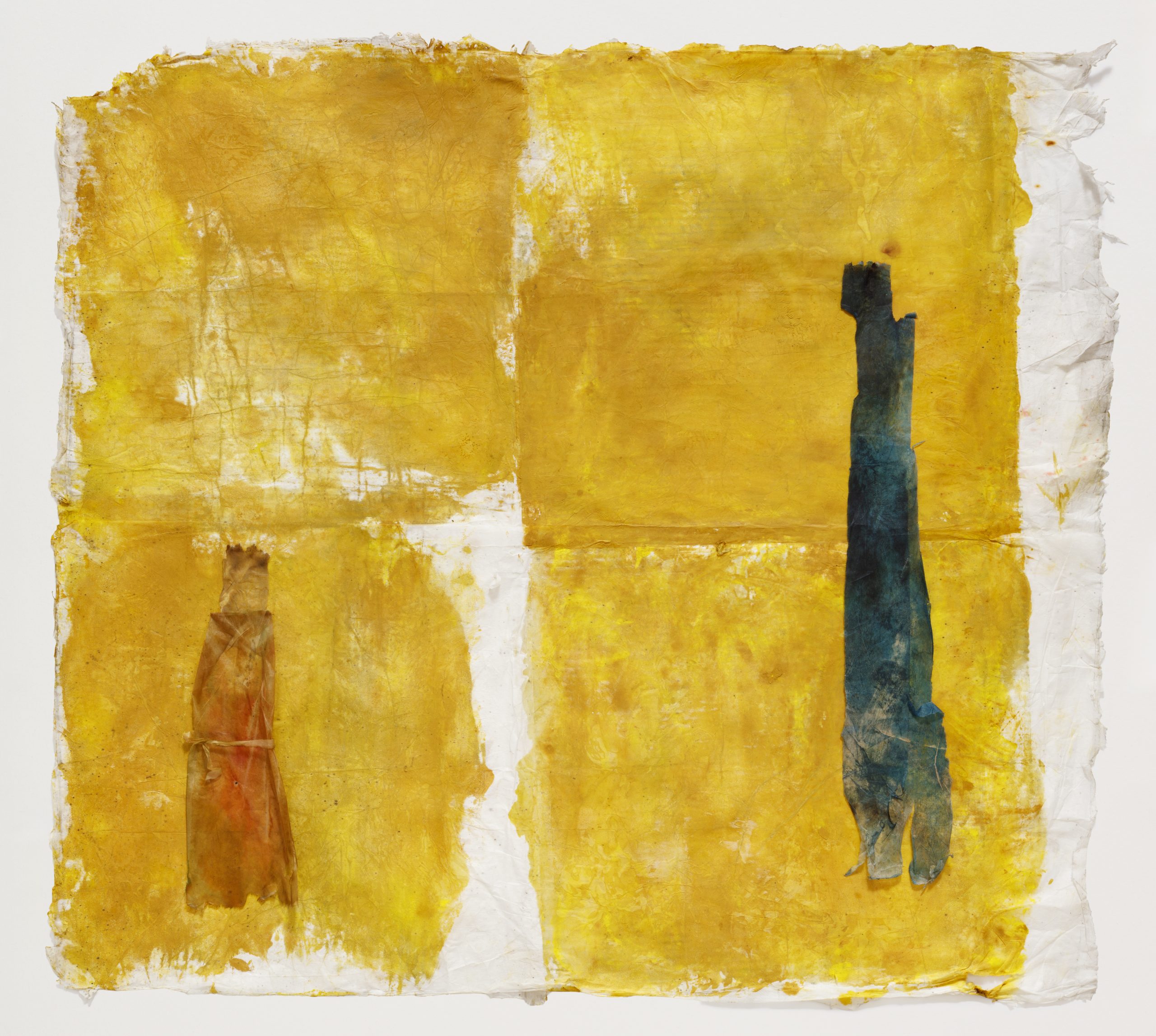
D. Quixote and Dulcinea
Oil, beeswax and oil on Japanese paper – 120x130cm
The Matter of Painting
by José Sousa Machado
“Listen
to the fragile brightness music leaves
as it burns in the dunes
once, I was that sand’s precarious light (…)”[1]
The title of Catarina Pinto Leite’s exhibition at Galeria Sá da Costa – “Palimpsesto” [Palimpsest] – is evocative of a common practice among medieval copyists: the erasing of manuscripts written on parchment or papyrus in order to write a new document or correct sections of pre-existing text.
The similitude between Catarina Pinto Leite’s present paintings and collages and the palimpsest – i.e. employing the same support to write a succession of texts – results from their processual common ground, in terms of using already finished works as supports for the creation of new ones.
Roughly two years ago, she showed at Galeria Diferença “Rua de mão única”, an installation in which visitors walked between translucent veils of Japanese paper that hung from the gallery’s ceiling, suggesting a street flanked by fluttering walls with varying degrees of transparency. After the closing of the exhibition, the installation was dismantled, and Catarina Pinto Leite reused the sheets of Japanese paper to create the paintings and collages shown here, working in a way akin to the palimpsest copyists to produce what we may call “figural palimpsests”.
The installation’s dismantling returned the paper to its original organic quality, once disconnected from the exhibitive concept; however, on the other hand it added to it a number of indelible traces of its previous use: a variety of thicknesses and textures, a watery translucence, an irregular rugosity, the deep creases left by crumpling, various casual or deliberate tears and overlapping sheets. It was on these materials so rich in history, experiences and memory that the artist now chose to work, painting them with Ecoline watercolours, oil paint and beeswax – rather than on some neutral matter, lacking the present materials’ biographical richness, which the viewer does not know, but nonetheless senses.
During the passage from the first to the second stage of this long creative process, the artist’s gaze evolved naturally from an initial speculative and conceptual scheme to a poetic and allegorical discourse on the nature itself of matter in painting. Moving through this eminently poetic dominion, while combining harmonies, chromaticism, rhythms and evanescent shapes free from any obvious representational purpose, Catarina Pinto Leite explored then the sensitive qualities of her materials, freed from the restraints of reason, as is usually the case with poetry and music. Like poetry – seen here as the essence of language, as a metalanguage – these pieces by Catarina Pinto Leite touch the limits of language, that which has yet to be named. Giorgio Agamben wrote about this in “The Idea of Matter”, stating that “what we reach is obviously not a thing so new and awesome that we lack the words to describe it; it is, rather, matter, in the sense in which one says, ‘the matter of Britain’ […] Where language stops is not where the unsayable occurs, but rather where the matter of words begins” – an undefinable substance that pulses at the root of what exists, “which the ancients called silva (wildwood)”, a pure preBabelian language that sings in unison with poet Antonio Delfini’s lines:
“When I finally reach the poem,
Sleep is beginning to reach you;
May my song be to you
Like a dream in your night.”
[1] Eugénio de Andrade, “Limiar dos pássaros”