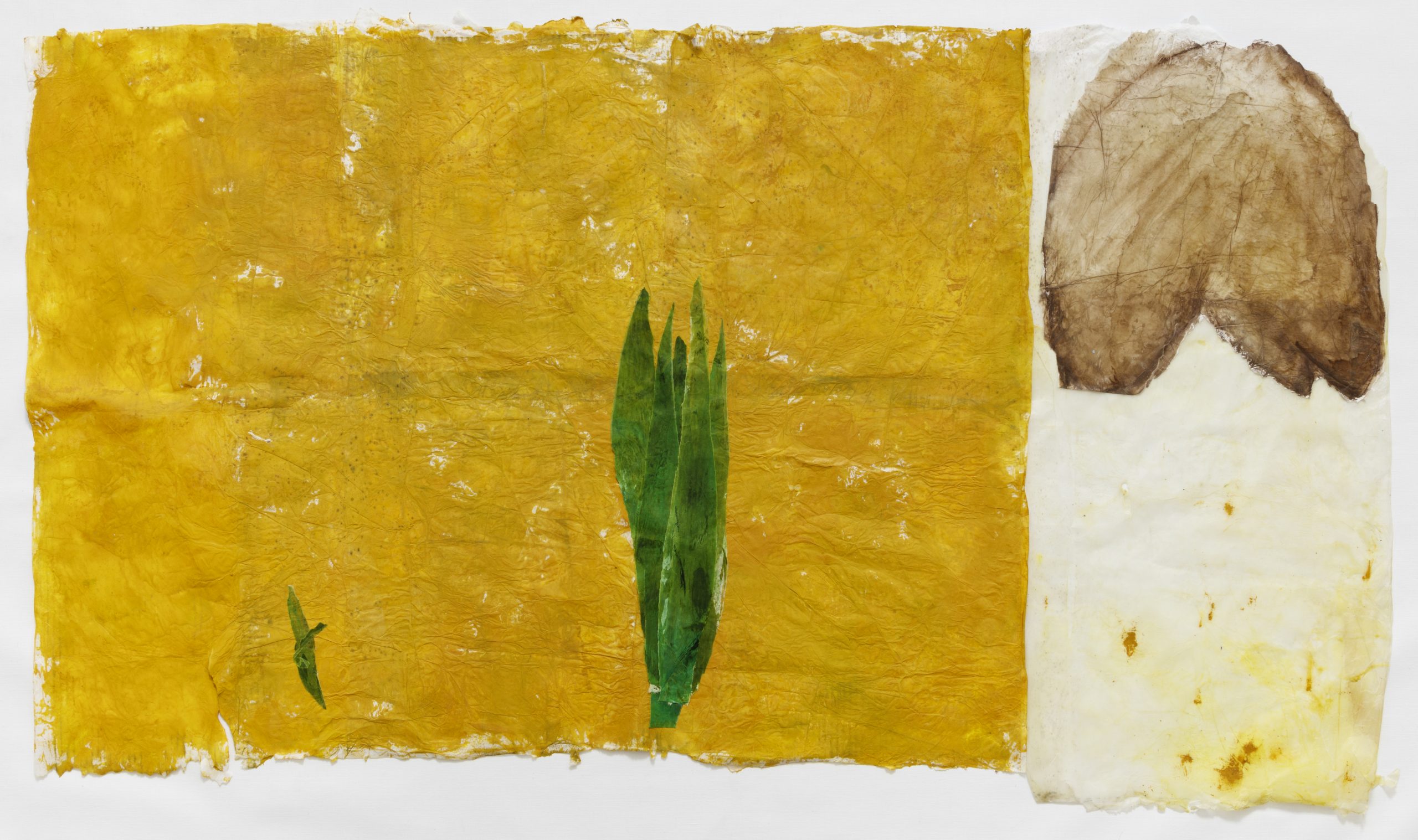
Among the hidden fields I
Beeswax and oil on Japanese paper – 100x170cm
Communicating Vases
The origin of the artist’s work is shrouded in mystery. Obviously, we can always list a series of references or identify a constellation of visual and conceptual stimuli that will help us to understand its genesis. But they will never tell us anything about the process of transformation that she brings about in the solitude of her studio, where those multiple memories are combined with an infinite number of other elements and then materialised on the surface of the paper or canvas.
When we visited Catarina Pinto Leite in her studio, she told us that this series, composed of paintings and drawings, was rooted in the memory of a trip that she made to Tuscany, during which she read Emily Dickinson’s book, Herbarium. Originally compiled between 1839 and 1848, this book was only published in the twenty-first century. The edition not only includes the facsimile of the collection of plants put together by the American poet, but also a set of poems relating to the theme of flowers. These two memories – the trip and the book – which, in Catarina Pinto Leite’s mind, cannot be dissociated from one another formed the basis for the works that we see here.
And, in fact, everything in these pieces is evocative of the plant world. Large-sized paintings, almost exclusively in shades of green, form the mantle on which her drawings are inscribed, all of them with a motif that stands out clearly against a textured background. As our visit and the conversation progress, we begin to discern other impressions that the author has highlighted in recent times, such as the trip that she made to Paris not so long ago to visit two retrospective exhibitions – of the work of Mark Rothko and Nicolas de Staël. And, besides the presence of multiple shades of green (ranging from emerald to Veronese green; from viridian to malachite), we also recognise in her paintings the citation of the subtle gradations of colours of the first of these artists, side by side with the impulse to discover the essential structure of objects, in the case of the latter. While we can group the paintings together under the generic title of landscapes, the drawings are much closer to still lifes, or, at least, to what, in contemporary art, remains from the ancient painting of objects and inanimate beings on a domestic background.
Forms on a background, we would say at first. And, here, we must return to Dickinson’s herbarium and to the visual impression that plants which have been dead for almost two hundred years create on the smooth white background surface. Time has yellowed and homogenised the richly-coloured shades of each flower, so that what we see today is a shadow, a vestige of what would have caught the attention of the poet and led her to collect and dry them, after which she stuck them in an album and then finally labelled them in her fine and delicate handwriting. Lourdes Castro’s herbarium is not very different from this one. And, in Catarina’s drawings, the passage of time is not to be found in her choice of colours, but instead in the process that the artist, for whom patience and expectation have always been an important feature of her work, allows us to glimpse in the finished work.
While, in Emily Dickinson’s book, we did not find any vases of flowers, death was much closer at hand than it was in the old pictorial genre of the still life, which placed plants, animals and opulent victuals in settings where the rich display of dishes, vases, cutlery or table linen could only be compared to the brilliance and chromatic saturation of the colours chosen by each painter. Today, Catarina Pinto Leite’s artistic process makes use, beyond painting, of the tearing of sheets of paper that are then joined together on the support in compositions that always work with the dialogue between figure and background. Of the old still life, what remains here is this constant dialogue between the form that we are given to see and the background that enables us to individualise it. In the paintings, however the first sensation that we have is that of a total immersion in the quintessential colour of the landscape – green – without it being necessary, from the painter’s point of view, to individualise it either in the form of a figure or of a sky through the presence of the line of the horizon. These landscapes, if, indeed, we may describe them as such, are much more on the side of the memory of the landscape (in the same way as still lifes were linked to the memory of flowers or of the herbarium) than they are on the side of the anachronistic permanence of pictorial genres created by History.
In this way, these communicating vases – the title that the painter has chosen for this series of works – communicate with history; first of all, her personal history, made up of memories of territories, journeys, paths, stories, readings, images and authors; and the collective history of painting and drawing, insofar as genres and works are appropriated from the past (as is the norm in contemporary art) and then updated to the present time. None of these vases are watertight, and they communicate with one another in many different ways.
Luísa Soares de Oliveira